

Support
Newsroom
| 카테고리 | Inner News |
| 제목 | Mobilint MLA100 NPU Test |
| 작성일자 | 2026-03-23 |
|
XSLAB Successfully Validates Mobilint’s High-Performance MLA100 NPU on V-Raptor SQ mini Edge Arm Server
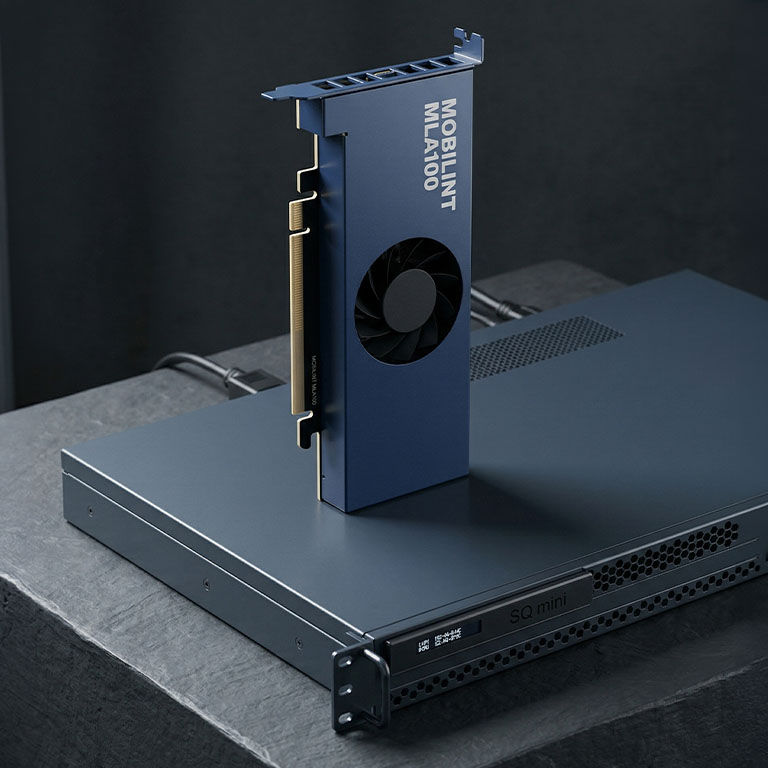
XSLAB has conducted a Proof of Concept (PoC) to measure computational performance and system stability by equipping its ultra-compact edge Arm server, the V-Raptor SQ mini, with the MLA100—a high-performance NPU developed by the Korean AI chipmaker Mobilint. The testing primarily focused on how reliably the AI inference device and network hardware could collaborate within an environment utilising a PCIe Gen 2 x1 expansion card.
LLM Performance Validation on PCIe Gen 2 x1
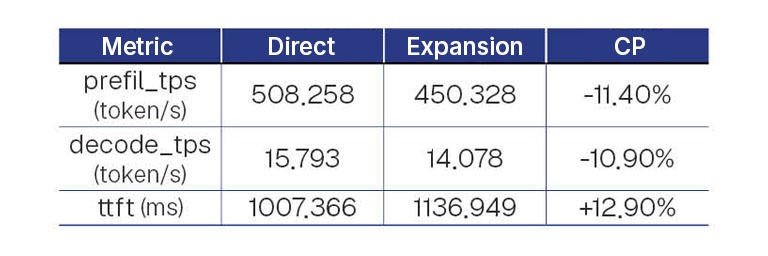
A central goal of this validation was to assess the practical performance of the MLA100 NPU under the physical constraints of a PCIe Gen 2 x1 slot. XSLAB analysed the results using the Llama-3.2-3B-Instruct model. The tests revealed that the performance gap between a direct connection and the use of an expansion card was successfully limited to approximately 11%.
Despite the narrow bandwidth of the x1 slot, the decode performance—representing actual inference speed—remained stable. This demonstrates that the SQ mini’s system design is efficient enough to fully support the NPU’s processing power.
Flexibility of ‘Global 8 Mode’
The Aries chip within the Mobilint MLA100 features an 8-core architecture that typically requires a PCIe x8 interface for optimal operation. However, XSLAB implemented ‘Global 8 Mode’ during this test, which distributes workloads across all eight cores via software control (qbruntime).
This proved that 100% of the computational resources could be allocated to all eight cores even in an extreme environment with only a single lane. By achieving this, XSLAB has secured greater flexibility in hardware configuration and presented a technical solution to resolve NPU availability issues through software optimisation.
Concurrent Stability of High-Volume Data Transfer and AI Inference
XSLAB went beyond simple performance metrics by conducting complex load tests that simulated real-world service environments. The NPU and a 10G NIC (Network Interface Card) were configured to share the same PCIe bus resources simultaneously.
Network Throughput: A loopback test using iperf3 achieved a measured bandwidth of approximately 4.80 Gbps. Considering the theoretical limit of 5 Gbps for PCIe Gen 2 x1, this represents the highest possible line rate.
Minimal Interference: When AI inference and high-volume data transfer were performed concurrently, the performance drop was negligible—staying within 1% compared to running the NPU alone.
These results indicate that the PCIe bus resource management within the SQ mini is exceptional. Even under high-load parallel tasks, the system maintained stability without freezing, calculation errors, or kernel panics.
A New Alternative for Edge AI Infrastructure
Through this validation, XSLAB’s SQ mini has proven its capability as an edge AI server equipped with high-performance NPUs like the Mobilint MLA100. It is particularly encouraging that high-performance AI inference and network processing can be realised simultaneously in environments with significant spatial constraints.
An official from XSLAB stated, “These test results are a significant milestone, proving that high-end AI services can be established even on ultra-small form factor servers. We remain committed to providing optimal edge AI infrastructure solutions through close collaboration with the domestic NPU ecosystem.”
|
|
| 첨부파일 | |
| 조회수 | 1192 |
| 다운로드수 | 0 |


|
